
Cultural heritage fortress monuments
All European regions have a rich heritage of fortified monuments and defence landscapes. This unique cultural heritage of „architectura militaris“ represents the special identity and attractiveness of Europe. Fortified towns and citadels, fortified palaces and castles, fortified sacred buildings, large fortresses and lines of defence tell of European history, of empires and dynasties. Representative of the important cultural heritage of the old continent, some fortresses are part of the UNESCO World Heritage.
As cultural sites for art, tourism, leisure, architecture and history, fortified monuments today offer a high potential for valorisation with economic effects for cities and regions. Mobilising this tourism and economic potential is part of ECCOFORT's work.
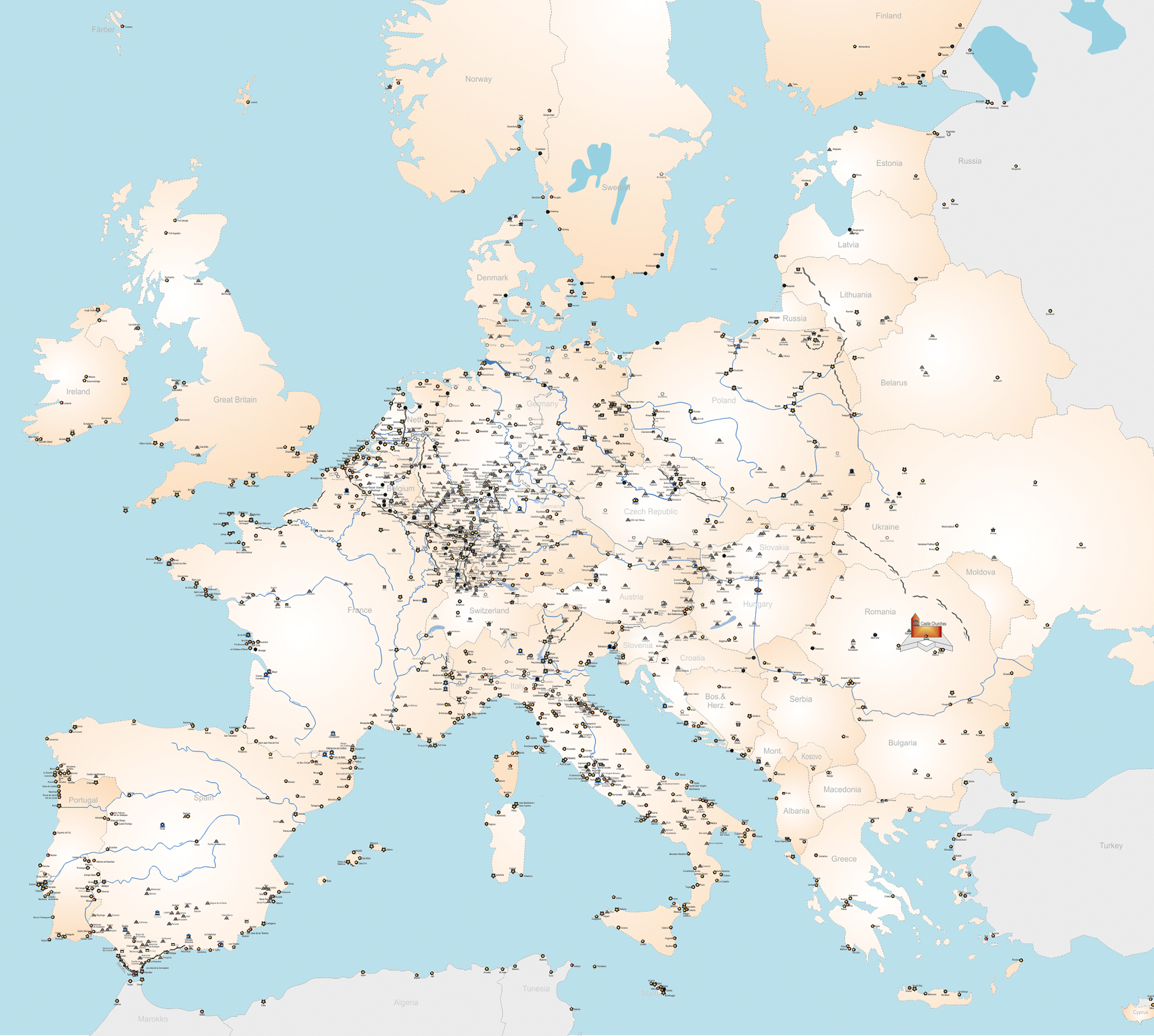
It is based on intensive ECCOFORT research into the identification, localisation and typification of the cultural heritage of fortified monuments from a touristic perspective. The resulting unique map series on the inventory and structure of the European cultural heritage of fortified monuments is one result.
Distribution in Europe
Under the direction of ECCOFORT e.V., the surprisingly high density and distribution of fortress architecture in Europe is being researched. The period under consideration is the epochs from the introduction of firearms to the founding of the European Union. For the Central European region ECCOFORT e.V. created an overview map of the cultural heritage of fortress monuments for the first time in 2006, which is constantly being updated.
Typing
The „architectura miltaris“ refers to the ancient art of building to protect people, their goods and their living space, an extraordinary cultural heritage from several millennia of European history.
Irrespective of any scientific, architectural or historical categorisation, ECCOFORT adopts a Catchy standardisation tailored to the tourism market into the following epochs.
I. Historical fortress construction
Epoch until 500 AD (Roman period)

Defence line
Elongated defence system for securing larger areas as a border fortress, line fortress or territorial fortress; e.g: Limes, Great Wall of China

Roman military camp, castrum
Regular geometric arrangement of a military camp with all contemporary protective facilities for military and service personnel; e.g: Saalburg (DE), Aosta (IT), Augst (CH)
Epoch 500 to 1500 (Middle Ages)

Medieval fortified town
A town surrounded by medieval fortifications, usually town walls with gates and defence towers; e.g: Ahrweiler, Bad Münstereifel, Zülpich (DE)

Medieval fortress
Medieval fortified castle / medieval castle with walls, ramparts, moats, towers - without fortification elements against artillery; e.g: Malbork (PL), Chateau Gaillard (FR), Lahneck Castle, Friedberg Castle, Sterrenberg Castle (DE)
Epoch 1500 to 1900 (modern times)

Single fortress
Stand-alone military defence structure, usually consisting of functional military buildings, ramparts, ditches, bastions and gun emplacements, e.g. Mont Royal Fortress, Rheinfels Fortress, Rosenberg Fortress, Königstein Fortress (DE): Mont Royal Fortress, Rheinfels Fortress, Rosenberg Fortress, Königstein Fortress (DE)

Fortified ideal city
Military town planned by military architects and engineers in the Renaissance with star-shaped or chessboard-like geometry of the streets and surrounding fortifications, e.g. Mannheim, Jülich (DE), Longwy, Neuf Brisach (FR), Terezin (CZ), Palmanova (IT): Mannheim, Jülich (DE), Longwy, Neuf Brisach (FR), Terezin (CZ), Palmanova (IT)

Fortified city
A city surrounded by modern fortifications in an irregular geometry
e.g.: Germersheim, Nuremberg (DE), Piacenza, Padua (IT)

Large-scale system
Central fortress with a ring-shaped chain of fortifications in front of it, such as forts and batteries, to secure towns and battlefields, e.g. Koblenz, Mainz (DE), Warsaw, Modlin (PL), Metz, Strasbourg (FR), Luxembourg (LUX): Koblenz, Mainz (DE), Warsaw, Modlin (PL), Metz, Strasbourg (FR), Luxembourg (LUX)

Citadel
Independent part of a fortified town, usually geometrically strongly developed with bastions; final retreat for defenders, e.g. Jülich, Mainz, Berlin (DE), Warsaw (PL), Diest (BE): Jülich, Mainz, Berlin (DE), Warsaw (PL), Diest (BE)

Fastened lock
Castle residence equipped with fortification elements, serving as protection against attackers or as an architectural decorative element, e.g: Eichstätt Castle (DE), Fürstenstein Castle (PL), Helsingor (DK)

Fortified castle
Medieval castle, which was supplemented or rebuilt with modern fortifications after the advent of firearms
e.g.: Hohenzollern Castle, Marburg (DE), Vianden (LUX), Eger (HU)

Fortified sacred building
Cathedrals, basilicas, monasteries, convents and also village churches, which are equipped with typical fortress components for the use of firearms, e.g: Ingelheim Castle Church (DE), Esztergom Basilica (HU), Melk and Göttweig Abbeys (AT)

Lines of defence
Elongated defence system for securing larger areas as a border fortification, line fortification or territorial fortification
e.g: Graacher Schanze, Queichlinie (DE), Torres Vedras (POR)
II Fortress construction of the 20th century
Epoch 1900 to 1945 (fortification construction of the world wars)

Bunkers and emplacements
Heavily fortified shelter or room complex in reinforced concrete construction, constructed underground as a deep bunker.
e.g: Heldsberg, Krattigen (CH)

 Designs as military bunkers, civilian air raid shelters or armaments bunkers.

Bunker system
Heavily fortified, large-scale system of underground protective and functional structures
e.g.: Komplex Riese, Wolf's Lair (PL)

Lines of defence
Elongated defence system for securing larger areas as a border fortress, line fortress or territorial fortress
e.g: West Wall, Atlantic Wall, Maginot Line, Molotov Line
Era 1945 to 1990 (fortress construction in the nuclear age and during the Cold War)

Bunker
Heavily fortified shelter or room complex in reinforced concrete construction, constructed underground as a deep bunker
e.g: Command bunker of the NVA and Bundeswehr, Bundesbank bunker Cochem (DE)

 Designed as a military bunker, civil defence facility or government bunker.
Lines of defence
Elongated defence system for securing larger areas as a border fortress, line fortress or territorial fortress
e.g: Iron Curtain

