
How the coronavirus pandemic is affecting fortress museums and monuments
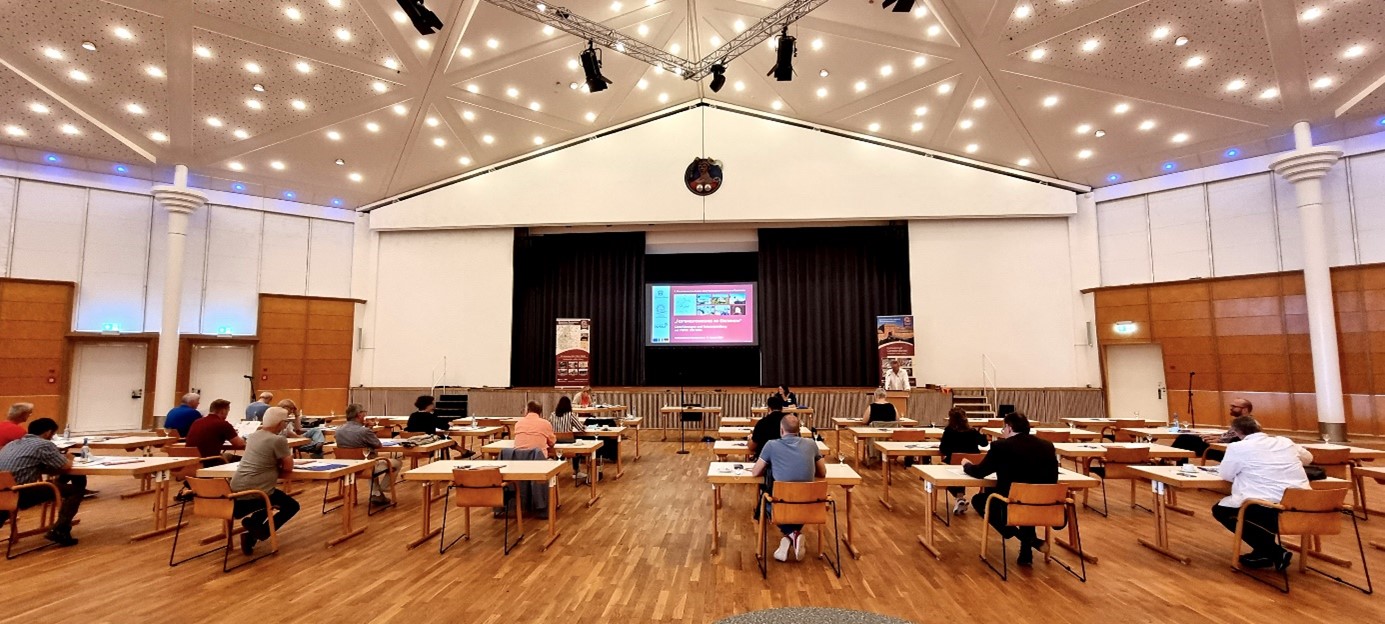
Conferences in Corona times - 4th symposium on the expansion of the Upper Rhine fortress cooperation on 11 August 2021 in the Germersheim town hall with over 30 participants
Factual article, published in the excursion guide Westwalltag, July 2021
Author: Dirk Röder
Everything that was said in last year's article still applies. Corona still demands a lot from us. Fourth wave, fifth wave, new mutations - nobody can say what's coming. Humans are adaptable, so they react. Depending on their individual constitution, initially to the vaccine serum. This (and the right app) gives them access to the vaccinated group. This in turn gives them access to restaurants, exhibitions and museums, to a reasonably normal cultural life.
Fortresses and museums benefit from this. Now experts in drawing up and implementing hygiene plans, visitor guidance systems and „corona-safe“ cultural programmes, they are able to meet the continuing high demand. So they are surviving and adapting. With digital ticket systems, online bookable visiting time slots, digital culture.
However, employees, unskilled labour and seasonal workers, e.g. in the areas of trade fair and event management or catering, were not so lucky. They had to reorient themselves in many places. In the catering industry in particular, many no longer saw any future at all and changed careers completely. This is now leading to a noticeable shortage of labour in restaurants, cafés and takeaway chains across Europe.
What we have learnt from Corona
Firstly, flexibility, through adaptation and improvisation, through appropriate strategic planning. Hygiene and self-protection continue to be the only effective measures against infection at present. Perhaps also patience or composure in the face of constantly new reports or the confusion of new rules and regulations every week at least.
But digitalisation in any case. Digital communication, digital cultural offerings, digital worlds of experience as an extension of real cultural offerings, digital admission, ticketing, control and measurement systems and much more are the big winners of the pandemic.
This is a great opportunity for the cultural heritage of fortress monuments, because digitalisation marks the next milestone in its evolution and thus secures its future. Because digital tools open up new target groups, ensure diversity and the removal of barriers, and revolutionise the dissemination of information. The coronavirus paved the way for this evolutionary step to be taken and completed much more quickly across the board.
Digitalisation is also a major step forward for FORTE CULTURA. The new self-image of digital communication has reduced the need for business travel by up to 90%. In addition, communication takes place at shorter intervals, allowing projects to be driven forward in an efficient and goal-orientated manner. The cultural route and the fortress network have been strengthened by the pandemic, although tourism was not possible or only possible to a very limited extent.
Networking in times of pandemic using the example of the Upper Rhine fortresses
The example of the Upper Rhine fortress region shows impressively what was and is possible despite all the restrictions. On the initiative of the fortress town of Germersheim, supported by FORTE CULTURA, the PAMINA Eurodistrict and the Baden-Alsace-Palatinate Tourist Association (Vis-à-Vis), a fortress community has been created as part of a cross-border project that currently includes 30 fortress monuments and museums on both sides of the Franco-German border.
See FORTE CULTURA Regional Profile Upper Rhine: www.forte-cultura.eu/oberrhein
A Franco-German image flyer with a regional map was jointly developed and printed in March 2021 with a print run of 100,000 copies. In addition, a stamp pass with a competition was developed and printed in a print run of 15,000 copies. Furthermore, a travelling exhibition on the „Fortress heritage of the last 350 years in the Upper Rhine region“ with 12 boards was developed and produced. All of this was achieved in many online meetings and without meeting in person once. The travelling exhibition even had to be „smuggled“ across the Franco-German border in times of contact bans and border closures so that it could be opened at the Musée de l'Abri de Hatten (FR).
In addition, the marketing campaign „Fortress Summer Upper Rhine 2021“ was prepared as part of the „European Fortress Summer“ and finally successfully launched on 15 April with a hybrid press conference. Over 90 events have been and will be organised in the participating museums and fortresses on the Upper Rhine and communicated using multimedia.
There were also 2 online workshops on the topic of „Social media for fortress monuments“, together with the FORTE CULTURA Elbe fortresses. The 4th symposium on the expansion of fortress cooperation on the Upper Rhine, on 11 August 2021 in Germersheim, was the first face-to-face event of the Upper Rhine fortress cluster since the start of the pandemic, and the topic „Guided tours and travel development with FORTE CULTURA“ was correspondingly future-oriented. On 9/10 October 2021, the „Fortress Summer Upper Rhine 2021“ will hopefully come to a glittering conclusion with a major fortress festival in Rastatt (DE). The consistently positive feedback on marketing tools, social media activities and events so far gives us confidence for the coming season, with or without the next wave of the pandemic.
It goes on. At least that's my impression when I correspond with fortress monuments all over Europe.
If you move, you change your position.


Leave a Reply